Sight-Size: the oldest trick in the atelier
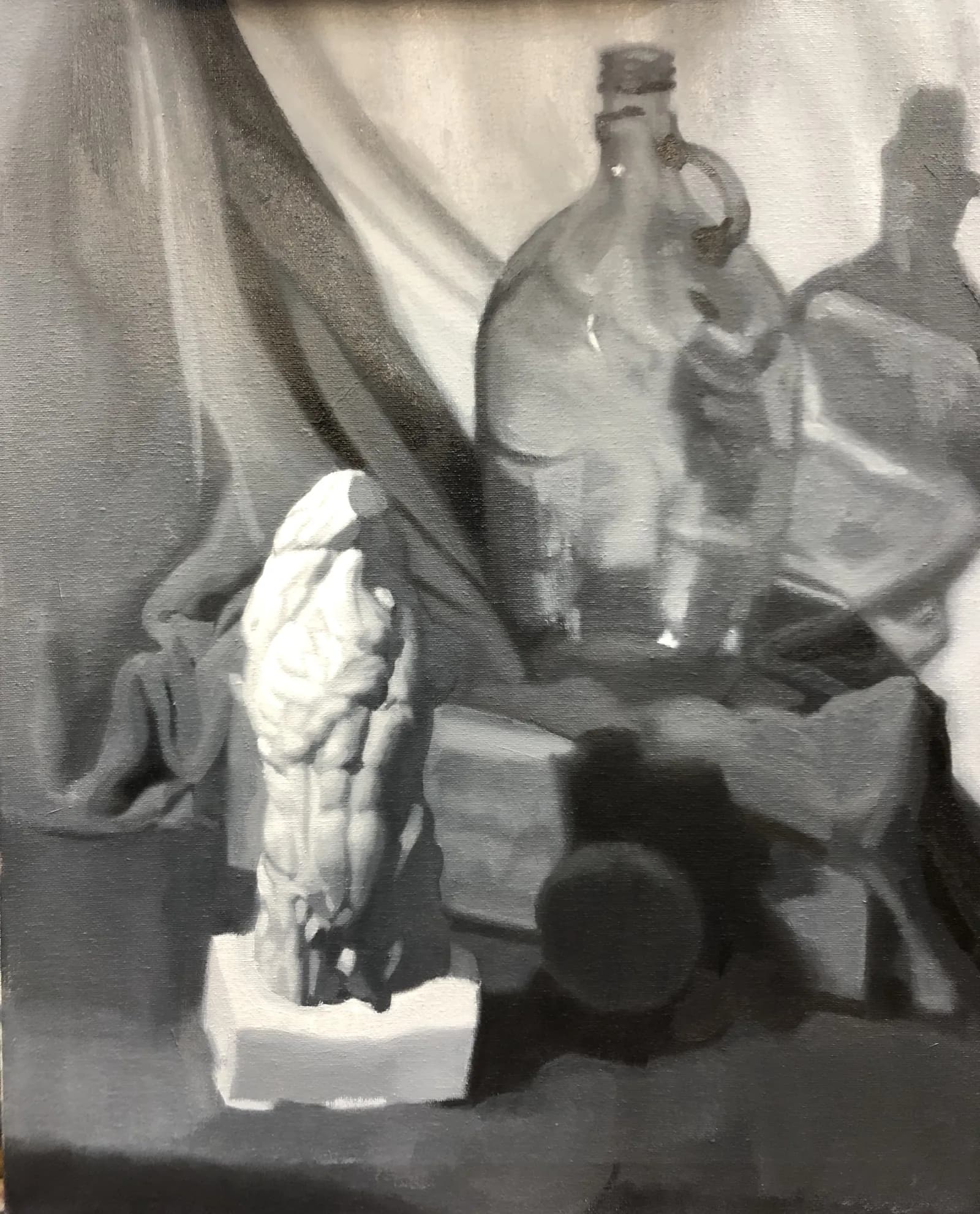
Put a drawing board beside the thing you are drawing. Set them so that from where you stand, the drawing and the subject appear the same size. Step back to a fixed spot — the same spot, every time — and look at both at once.
That is sight-size. It is several hundred years old, it requires no equipment beyond an easel and a piece of string, and it is the first thing we teach.
What it is actually for
Most people cannot draw what is in front of them because they are not drawing what is in front of them. They are drawing what they know: eyes sit halfway down a head, so they put them higher, because a lifetime of looking at faces up close says eyes are near the top. A cup is circular, so its opening gets drawn rounder than the ellipse actually reaching the eye.
None of that is a hand problem. It is the mind filling in what it expects before the eye has finished looking.
Sight-size removes the argument. When the drawing and the subject are the same apparent size, side by side, you are no longer comparing a drawing to an idea — you are comparing two things in the same visual field. A shape that is wrong is visibly wrong. You do not need anyone to tell you.
The part people resist
Standing back is not optional, and it is where most beginners quietly cheat.
The whole method depends on always looking from the same place, because everything you are measuring — the angle of a shoulder, how far the shadow travels, the width of a jaw against its height — changes the moment your head moves. Students lean in to work on a detail and then judge it from six inches away. The detail is then right for a view nobody will ever have of the drawing.
The discipline of walking back to the same spot, dozens of times an hour, is the actual training. It is tedious for about three weeks. Then something shifts.
What changes
Somewhere in the first six months, the thing people say changes. It stops being that their drawing improved and becomes that the world looks different.
Shadows have edges that are sharp in one place and soft in another. A white wall is four colors. The gap between two objects has a shape of its own, as definite as the objects. None of this is new information — it was always in the room. What changed is that the eye now stops on it instead of skating past.
That is what we mean by learning to see, and it is the reason the first act of the year is given to it entirely. Everything afterward — anatomy, the figure, painting, and eventually work that is yours rather than an exercise — is built on being able to trust what you are looking at.
Does it make everyone draw the same way?
It is a fair worry, and it is the standard objection to academic training.
The honest answer is that sight-size is a measuring method, not a style. It tells you whether the shape is right. It has nothing to say about what you choose to draw, what you leave out, how hard you press, or what you are trying to make someone feel. Those decisions only become available once accuracy is not costing you all your attention.
You cannot break a rule usefully until you can keep it on demand.
Keep reading
Six months in, your eye changes before your hand does
Nobody arrives expecting the change to happen outside the studio. Six months in, the thing people describe is not better drawings — it is that shadows have edges and a white wall has four colors.
Why we draw from plaster before we draw from people
A plaster cast will hold a pose for six weeks without breathing, shifting its weight, or getting a haircut. That is the entire argument, and it is a good one.